

Arisaema triphyllum, commonly known as Jack-in-the-Pulpit, is one of the most memorable woodland plants found in eastern North America. In Quebec, this spring wildflower stands out for its distinctive hooded flower structure, elegant trifoliate leaves, and preference for rich, moist forest habitats. Gardeners, hikers, native plant enthusiasts, and anyone learning the flora of Quebec often remember this plant immediately once they have seen it in the field.
This guide explores how to identify Arisaema triphyllum, where it grows in Quebec, what role it plays in forest ecosystems, and why it remains such an important species for nature interpretation and botanical education. If your goal is to understand a striking native plant that combines unusual form with real ecological value, Jack-in-the-Pulpit is a perfect species to study.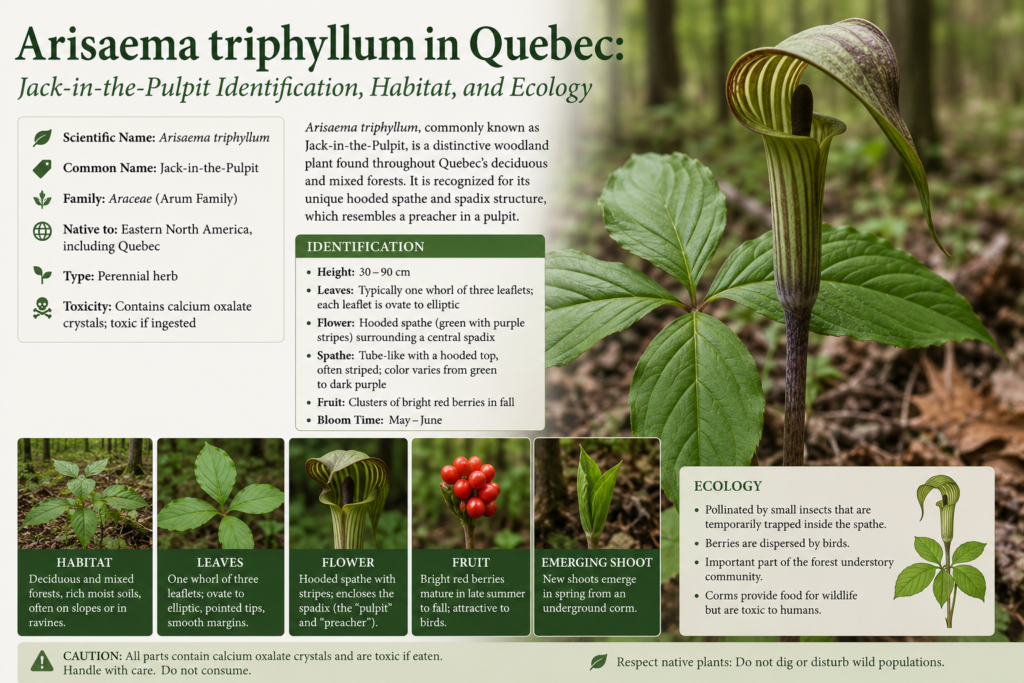
What Is Arisaema triphyllum?
Arisaema triphyllum is a herbaceous perennial in the arum family, Araceae. Unlike many showy garden flowers, its visual impact comes from architecture rather than bright petals. The most recognizable feature is the hooded spathe, often striped green and maroon or purple, which curves over a central spike called the spadix. This dramatic shape gives rise to the common name Jack-in-the-Pulpit, because the spadix appears to stand like a preacher inside a pulpit.
The plant usually produces one or two leaves, and each leaf is divided into three leaflets. Those three leaflets are the source of the species name triphyllum, which refers to “three leaves,” though botanically they are leaflets within a compound leaf. This growth form, paired with the hooded inflorescence, makes the plant easy to distinguish from most other spring flora once you know what to look for.
How To Identify Jack-in-the-Pulpit in Quebec
The easiest way to identify Arisaema triphyllum is to combine leaf shape, flower form, and habitat. Mature plants often reach roughly 20 to 65 centimeters in height, though local growing conditions can make specimens smaller or more vigorous. The leaves are smooth, broad, and pointed, with three clear leaflets radiating from a single point. In shaded forests, the foliage often appears lush and fresh green through spring and early summer.
The flower structure is what turns a probable identification into a confident one. The spathe forms a curved hood around the spadix, with coloration that can vary from mostly green to green strongly marked with brownish purple stripes. Seen from the side, it resembles a narrow shelter or folded banner. No other common spring plant in Quebec forests combines this exact hooded structure with the three-part leaf arrangement.
Later in the season, the inflorescence gives way to a cluster of berries. These fruits start green and become bright red when mature, creating another memorable seasonal stage. For field naturalists, that means the species can be recognized not just in bloom, but also in fruiting condition well after the spring flowering window.
Typical Habitat and Range in Quebec
In Quebec, Jack-in-the-Pulpit is associated mainly with rich deciduous or mixed forests, especially sites with moist but not stagnant soils. It often appears in maple forests, floodplain woodlands, shady ravines, and other habitats where organic matter is abundant and summer drought is limited. The species prefers humus-rich ground and tends to perform best where leaf litter and woodland moisture create cool, stable conditions.
Because it favors relatively fertile environments, its presence can sometimes signal a healthy understory with good structural diversity. It is not a plant of highly exposed dry sites, nor is it typical of harsh, compacted habitats. When looking for it in Quebec, the best approach is to search spring woodlands with partial to full shade, especially areas supporting other moisture-loving native herbs and spring ephemerals.
Distribution can vary by region, microclimate, and soil type, but the species is broadly tied to the southern and temperate forested portions of the province where suitable hardwood and mixed woodland communities occur. Local abundance may be scattered, with some forests supporting only a few plants and others holding more noticeable colonies.
Flowering Season and Life Cycle
Jack-in-the-Pulpit is most often noticed in spring, when its leaves and floral structure emerge from the forest floor after snowmelt. In Quebec, flowering generally takes place from late spring into early summer depending on latitude, elevation, and weather conditions. Plants emerge from underground corm-like structures that store energy from previous growing seasons.
One especially interesting feature of Arisaema triphyllum is that plant sex expression can shift with plant size and vigor. Smaller plants may function as male, while larger and better-resourced individuals may produce female flowers, a strategy that helps the species balance reproductive cost. This dynamic makes the biology of Jack-in-the-Pulpit more complex than its quiet woodland habit might suggest.
After pollination, fruiting plants develop clusters of berries that gradually enlarge through the growing season. By late summer, the fruits may become vivid red and remain visible even after leaves have begun to decline. These seasonal transitions give the plant more than one moment of visual importance in the woodland calendar.
Pollinators and Ecological Role
Although it does not produce the kind of broad open flower that attracts large numbers of bees or butterflies, Jack-in-the-Pulpit plays a specialized ecological role. Small flies and gnats are often associated with its pollination system. The flower structure can function in a way that temporarily traps tiny insects, guiding pollen transfer between male and female stages or between different plants.
This strategy reminds us that forest biodiversity depends not only on conspicuous pollinator relationships but also on more subtle interactions involving shade-adapted insects and highly specialized floral designs. In a Quebec woodland, Arisaema triphyllum contributes to ecological complexity by supporting these relationships and by adding structural diversity to the herb layer.
The red berries also have ecological significance. While the plant is not a dominant food source on the landscape, fruits can attract wildlife and become part of broader seasonal food webs. The plant’s presence in intact forests further contributes to the overall richness that makes these habitats resilient and biologically interesting.
Why This Plant Matters for Native Plant Education
From an educational perspective, Jack-in-the-Pulpit is invaluable. It is unusual enough to capture attention immediately, but common enough in suitable habitats that people exploring southern Quebec forests may realistically encounter it. That combination makes it one of the best gateway species for teaching forest plant identification, floral anatomy, and habitat observation.
It also helps demonstrate that “wildflowers” are not all built around the same visual model. Many beginners expect flowers to have obvious petals, bright colors, and a familiar shape. Arisaema triphyllum breaks that expectation. It introduces learners to the arum family, to the concept of a spathe and spadix, and to the idea that plant beauty can be structural, subtle, and highly adapted.
For nature guides, teachers, and botanical writers, this species offers a natural bridge between simple field identification and deeper ecological storytelling. It invites questions about pollination, forest soil quality, fruiting cycles, and adaptation to shade. Few woodland plants provide so much interpretive value while remaining so visually distinct.
Can You Grow Arisaema triphyllum?
Native plant gardeners sometimes seek out Jack-in-the-Pulpit for shade gardens, woodland restorations, or naturalized plantings. In the right setting, it can be a remarkable ornamental because it looks refined, unusual, and unmistakably tied to eastern forest ecology. However, it should be grown in conditions that resemble its natural habitat: rich soil, dependable moisture, organic matter, and partial to full shade.
It is not a species for hot, dry borders or heavily disturbed sites. Gardeners who want success should think in terms of woodland layering rather than decorative bedding displays. Companion species might include native ferns, spring woodland herbs, and moisture-loving forest perennials. Because the plant emerges and performs on a seasonal rhythm, it works best in gardens designed around ecological realism rather than constant floral display.
As with many native plants, responsible sourcing matters. Plants should come from ethical nurseries rather than wild collection. Protecting natural populations in Quebec forests is far more important than short-term ornamental demand.
Is Jack-in-the-Pulpit Edible?
This is a plant where caution is essential. Raw plant tissues contain compounds that can cause intense irritation, and the species is generally considered toxic if handled or consumed improperly. Historical use by knowledgeable people involved careful processing, but that does not make it a beginner-friendly edible plant. For modern readers, the safest guidance is straightforward: appreciate Arisaema triphyllum as a native woodland species, not as a casual food source.
That warning is also part of good botanical literacy. Not every plant that appears in a forest guide should be treated as edible, medicinal, or suitable for experimentation. Accurate nature education includes teaching respect, observation, and restraint.
Conservation and Respectful Observation
Jack-in-the-Pulpit benefits from intact woodland conditions. Habitat fragmentation, trampling, invasive species pressure, and changes in hydrology can all reduce the quality of the environments where it grows. While the species may not be the rarest plant in Quebec, its long-term well-being is linked to broader forest health.
For photographers and hikers, the best practice is simple: stay on durable surfaces where possible, avoid crushing nearby understory plants, and never remove fruiting stems or dig plants from natural sites. Because woodland herbs often exist in fragile communities, a single careless step can affect much more than one plant.
Respectful observation is especially important in spring, when soils can be soft and many native species are emerging at once. A careful naturalist leaves the habitat looking as undisturbed as possible.
Final Thoughts
Arisaema triphyllum is one of the most distinctive native woodland plants a person can encounter in Quebec. Its sculptural flower, three-part leaves, red fruits, and preference for rich, shady forests make it both easy to remember and deeply rewarding to study. Whether you are building a personal field list, teaching forest botany, planning a native shade garden, or simply learning the signature plants of Quebec, Jack-in-the-Pulpit deserves a place near the top of the list.
More than a curiosity, it is a species that reveals how much sophistication exists in the forest understory. Learn to recognize it once, and you will never mistake it again. That is part of what makes it such a powerful ambassador for the flora of Quebec.