

Acer spicatum is a understory maple or large shrub that deserves much more attention from anyone studying the flora of Quebec. Whether you are a hiker, naturalist, student, gardener, or photographer, this plant offers a useful entry point into habitat reading, field identification, and the wider ecological patterns that shape landscapes across the province. The strongest way to understand any native or naturalized species is not only to learn its name, but also to understand how form, season, and habitat fit together in the field.
In practical terms, mountain maple is a characteristic woody plant of northern forests and a useful indicator of moist, shaded habitats. That makes this species especially useful for creating a more observation-based approach to field botany. Instead of treating identification as memorizing a label, it becomes a way to notice forest structure, wetland moisture, disturbance, soil quality, light conditions, and seasonal timing. This guide focuses on the characteristics most helpful for recognizing Acer spicatum in Quebec and understanding where it fits in the larger natural picture.
Overview of the Species
Acer spicatum should be understood first as a plant of cool forest edges, rich slopes, and mixed woods. In the field, that ecological setting often tells you almost as much as morphology does. When a species appears consistently in a certain kind of place, it becomes part of the language of that habitat. Learning it therefore helps with more than one identification. It helps you build pattern recognition across entire plant communities.
Many of the most useful field plants in Quebec are not necessarily the rarest or the showiest. They are the species that reliably teach observers how landscapes function. Acer spicatum belongs in that category because it contributes structure, seasonal presence, and ecological meaning. Once you become familiar with it, you start noticing the company it keeps and the kind of site conditions it seems to prefer.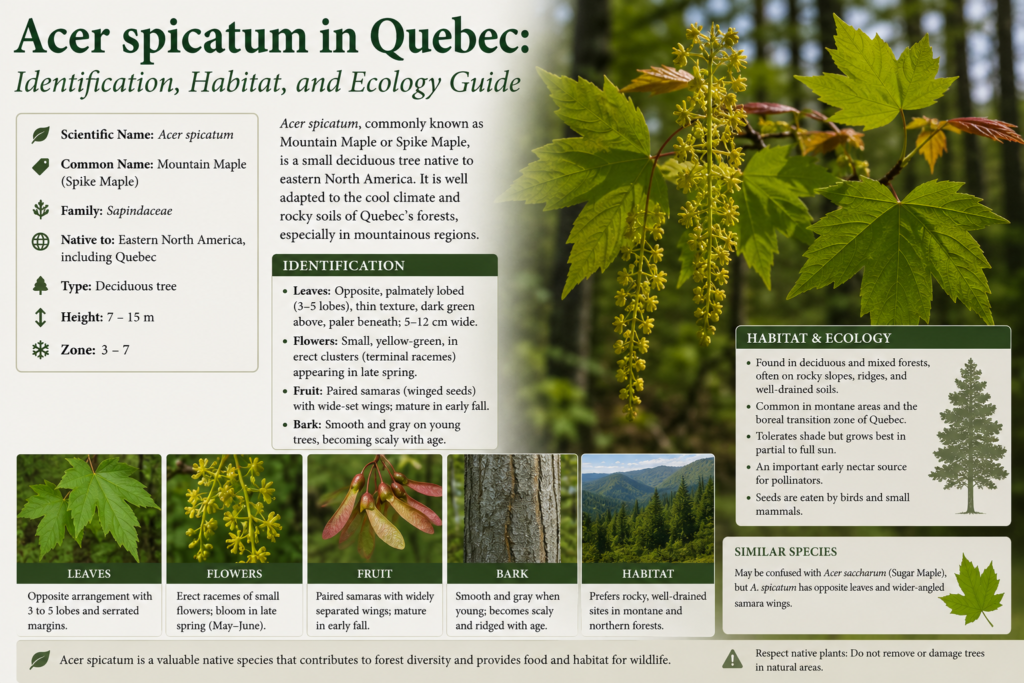
How To Identify Acer spicatum
The most reliable approach is to look at growth form, foliage pattern, reproductive structures when present, and the immediate habitat. Observers should pay attention to overall posture first. Is the plant upright, creeping, clumping, arching, vining, or spreading? Then look at leaf arrangement, texture, margins, and the way the plant occupies space. These features are often more durable and more helpful in real field conditions than a single close-up detail.
Season matters as well. Some species are easiest to identify in flower, others in fruit, and others by sterile foliage. In Quebec, where snow cover and short growing seasons create strong seasonal pulses, seeing a plant at the right time can dramatically simplify identification. The best naturalists therefore revisit the same species across multiple months so they can recognize juvenile growth, mature vegetation, flowering or sporing stages, and late-season decline.
With Acer spicatum, the safest field method is to pair morphology with place. If the plant matches the expected form and is growing in the kind of site where it typically thrives, confidence rises quickly. If the plant seems out of habitat, observers should slow down and compare additional details before making a final call.
Habitat in Quebec
Across Quebec, habitat is one of the strongest interpretive tools available to plant learners. In the case of Acer spicatum, the species is most meaningfully discussed in connection with cool forest edges, rich slopes, and mixed woods. Those environments are not random backdrops. They provide the moisture regime, light exposure, soil chemistry, and disturbance history that make successful growth possible.
This is why plants like Acer spicatum are so useful in field guides. They are not isolated facts. They are indicators. A botanist seeing this species may begin asking wider questions: Is the soil acidic or richer than expected? Is the site recently disturbed or relatively stable? Is moisture seasonal, constant, or flooding driven? Does the surrounding vegetation suggest shade tolerance, coastal exposure, peat influence, or fertile alluvium? A single plant can open the door to that kind of ecological reading.
For people exploring Quebec casually, the takeaway is simple: always study the neighborhood around the species. The surrounding plants, canopy, slope, shoreline, litter layer, and hydrology will often tell you why the species is there and help you find it again elsewhere.
Ecological Importance
No plant exists alone. Acer spicatum contributes to the ecological texture of its habitat by participating in relationships with insects, microorganisms, neighboring vegetation, and sometimes birds or mammals. Even when a species is not dominant at the landscape scale, it may still be important as part of a specific stratum such as the understory, wetland edge, shoreline matrix, or early successional layer.
Understanding ecological role also improves conservation literacy. People are less likely to dismiss or damage a species when they understand what it contributes. A plant may stabilize soil, support pollinators, provide cover, influence nutrient cycling, or simply add to the structural diversity that makes a habitat resilient. Acer spicatum is best appreciated in that broader sense, not just as an isolated specimen.
Final Thoughts
Acer spicatum is exactly the kind of plant that rewards close attention. It has enough character to stand out, enough ecological context to teach something meaningful, and enough field relevance to matter for anyone exploring Quebec flora seriously. By learning how to identify it, where to find it, and what it suggests about the land around it, readers gain more than one species profile. They gain a more useful way to read nature itself.
That is the core value of a strong Quebec plant guide: helping people move from isolated names to living landscapes. Acer spicatum belongs firmly in that conversation.