

Agarum Cribrosum: Sea Colander Kelp of Cold Northern Waters
Agarum cribrosum, often called sea colander, sieve kelp, or perforated kelp, is a distinctive brown algae known for its unusual blade covered with natural openings. These holes give the species a delicate, lace-like appearance and make it one of the more recognizable seaweeds found in cold northern marine environments.
Although it is not a land plant, Agarum cribrosum belongs to the broader natural heritage of coastal and marine ecosystems connected to eastern Canada. For naturalists, shoreline explorers, students, and photographers, this species offers a useful introduction to the diversity of algae living beyond forests and freshwater habitats.
Quick Identification
- Scientific name: Agarum cribrosum
- Common names: Sea colander, sieve kelp, perforated kelp
- Group: Brown algae
- Habitat: Cold marine waters, rocky subtidal zones, kelp communities
- Appearance: Broad brown blade with many natural perforations
- Ecological role: Shelter, structure, and habitat support for marine life
What Makes Agarum Cribrosum Distinctive
The most recognizable feature of Agarum cribrosum is its perforated blade. Unlike torn seaweed damaged by waves or animals, the openings in this kelp are part of its natural structure. The blade may look like a sheet with many rounded or irregular holes, almost as if it had been carefully cut by hand.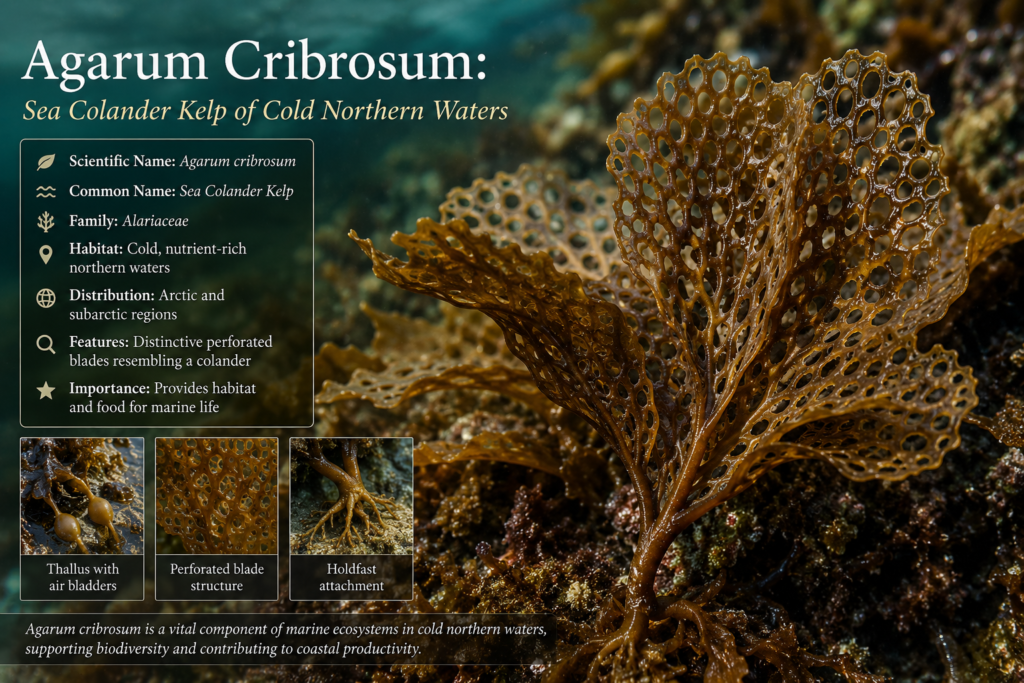
This form helps distinguish it from many other kelps that have smooth, strap-like, or divided blades. The perforations also create a lighter structure that can move with underwater currents without tearing as easily as a solid sheet of similar size.
Habitat and Growing Conditions
Agarum cribrosum is associated with cold marine environments where rocky surfaces provide attachment points. Like many kelps, it anchors itself using a holdfast rather than true roots. The holdfast grips rock or stable substrate while the blade extends upward into moving water.
It is most often found below the low tide line in subtidal habitats, where it remains submerged for long periods. Clear, cold, nutrient-rich water supports healthy kelp growth. Strong currents and wave movement are not necessarily harmful when the algae has secure attachment and suitable substrate.
Structure of the Alga
Although seaweeds may resemble plants, their structure is different from vascular land plants. Agarum cribrosum does not have true roots, stems, flowers, or seeds. Instead, it has a holdfast, a stipe, and a blade.
The holdfast attaches to rock. The stipe supports the blade. The blade is the broad photosynthetic surface where light is captured. In Agarum cribrosum, this blade is the most visually striking part because of its perforated pattern.
Ecological Importance
Kelp species contribute structure to underwater habitats in much the same way that trees contribute structure to forests. They provide shelter, feeding surfaces, and nursery areas for many marine organisms. Small invertebrates, juvenile fish, snails, crustaceans, and other algae may all use kelp beds as part of their habitat.
Agarum cribrosum helps add complexity to cold-water marine communities. Its blade creates surfaces where organisms can settle, hide, or feed. Even after pieces break loose, drifting or washed-up kelp can contribute organic matter to shoreline food webs.
Seasonal Observation
Because Agarum cribrosum usually grows in submerged marine environments, it is not always easy to observe from shore. Pieces may occasionally wash onto beaches after storms or strong tides. These stranded fragments can provide useful identification opportunities, especially when the perforated blade is still intact.
Fresh material is usually brown to olive-brown and flexible. Older beach-washed pieces may darken, dry, tear, or lose their original shape. For accurate identification, look for the repeated natural holes across the blade rather than relying only on color or size.
Similar Seaweeds
Other brown algae may be confused with Agarum cribrosum when they are damaged or partially decomposed. Torn kelp blades can appear perforated, but the openings are usually irregular breaks rather than consistent structural features. Sea colander has a more organized pattern of natural holes across the blade.
When comparing species, observe the whole structure if possible: blade shape, thickness, attachment point, stipe, and the arrangement of openings. A single fragment may not always provide enough information for confident identification.
Responsible Coastal Observation
Marine habitats are sensitive, especially rocky shorelines, tide pools, and kelp communities. When exploring coastal areas, avoid pulling attached algae from rocks. Many species grow slowly or provide habitat for small organisms that are not immediately visible.
- Observe attached algae without removing them.
- Walk carefully on wet rocks and avoid crushing tide pool life.
- Do not collect large amounts of seaweed from natural habitats.
- Photograph specimens in place when possible.
- Respect local rules in protected coastal areas.
Photography Tips
Agarum cribrosum is highly photogenic because of its patterned blade. If found on shore, photograph it in soft natural light to capture the texture and perforations clearly. A dark rock, wet sand, or shallow water background can make the holes easier to see.
For useful documentation, take one close-up of the blade pattern, one image of the entire specimen, and one wider image showing the surrounding shoreline or habitat. These views help preserve context for later study.
Why This Species Matters
Agarum cribrosum reminds observers that natural diversity is not limited to forests, wildflowers, birds, or mammals. Marine algae are essential members of coastal ecosystems, shaping underwater habitats and supporting life in ways that are often hidden from casual view.
Its unusual structure also makes it a strong teaching species. The perforated blade invites questions about adaptation, wave movement, underwater light, marine habitat, and the difference between algae and land plants.
Field Summary
Agarum cribrosum is a cold-water brown algae recognized by its broad blade filled with natural perforations. It grows attached to rocky marine substrates and contributes structure to kelp communities. While it is not always visible from shore, beach-washed specimens can help naturalists learn its distinctive appearance.
For anyone studying Quebec and eastern Canada’s natural environments, this species expands attention beyond terrestrial landscapes and into the rich marine world connected to northern coasts. Observed carefully and respectfully, sea colander kelp offers a clear example of how form, habitat, and ecological function come together in cold-water nature.