

Trillium Erectum in Quebec: A Practical Field Guide to Red Trillium
Trillium erectum, commonly known as red trillium, wake-robin, purple trillium, or stinking Benjamin, is one of the most recognizable spring wildflowers found in eastern North American forests, including many suitable woodland habitats in Quebec. Its deep red to maroon flower, three broad leaves, and early-season bloom make it a memorable plant for hikers, naturalists, photographers, and anyone who enjoys observing forest life with care.
This guide is written for people exploring Quebec’s natural spaces who want to understand how to identify Trillium erectum, where it grows, when it flowers, and how to observe it responsibly. Like many native woodland plants, red trillium is best appreciated in place. It belongs to a slow, seasonal forest rhythm where soil, shade, moisture, insects, fungi, and tree cover all work together.
Quick Identification
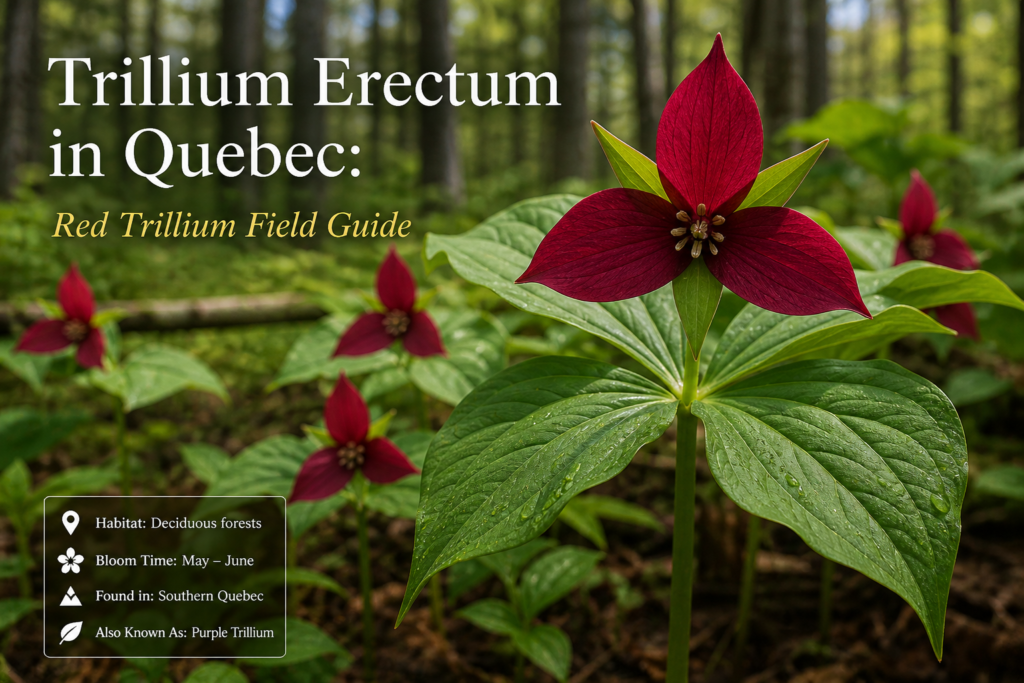
Red trillium is usually easy to recognize once you know its basic structure. The plant has a single upright stem topped by three large, leaf-like bracts arranged in a whorl. Above them sits a solitary flower with three petals and three sepals. The flower is often dark red, burgundy, or purplish, although color can vary. Some plants may appear lighter, duller, or brownish depending on age, lighting, and local conditions.
- Scientific name: Trillium erectum
- Common names: Red trillium, purple trillium, wake-robin, stinking Benjamin
- Flower color: Usually dark red, maroon, purple-red, or burgundy
- Bloom period: Spring, often from late April through May depending on location and weather
- Habitat: Moist deciduous or mixed forests, shaded slopes, rich woodland soils
- Growth form: Herbaceous perennial wildflower
What Makes Trillium Erectum Distinctive
The name “trillium” reflects the plant’s repeated pattern of threes. Red trillium normally has three broad bracts, three sepals, and three petals. This balanced form makes it one of the easier spring wildflowers to identify, even for beginners. The flower sits directly above the bracts and often faces outward or slightly upward, depending on the plant’s maturity and growing position.
One of the plant’s most unusual traits is its scent. Trillium erectum may give off a faint odor that some people compare to wet fur, carrion, or decaying organic matter. This is not a flaw in the plant. It is part of its pollination strategy. The scent can attract certain flies and beetles that visit the flower in early spring. Not every plant smells strongly, and the odor is often more noticeable when the flower is fresh and weather conditions are warm enough.
Where Red Trillium Grows in Quebec
In Quebec, Trillium erectum is associated with forested areas that offer shade, moisture, and relatively rich soil. It is most often found in deciduous or mixed woodlands where the spring sun reaches the forest floor before the tree canopy fully closes. This short seasonal window allows many woodland wildflowers to grow, flower, and store energy before summer shade becomes dense.
Look for red trillium along mature forest trails, near shaded stream edges, on gentle slopes, and in areas with deep leaf litter. It may grow near sugar maple, yellow birch, beech, hemlock, fir, and other trees depending on the region. The plant does not need open sun. In fact, too much direct exposure can dry the soil and make the habitat less suitable.
Good habitat often has loose organic matter, decomposing leaves, mossy patches, and a quiet woodland floor that has not been heavily disturbed. Trilliums are not plants of lawns, road shoulders, or compacted paths. When they appear near trails, it is usually because the surrounding forest still provides the conditions they need.
Blooming Season and Best Time to Observe
Red trillium is a spring ephemeral or near-ephemeral woodland plant. It emerges early, flowers during the cool part of the season, and uses the brief period before full canopy shade to complete much of its annual growth. In southern parts of Quebec, flowering may begin in late April or early May. Farther north or at higher elevations, the season may shift later.
The best time to observe Trillium erectum is usually during a calm spring walk after the forest floor has warmed but before summer vegetation becomes dense. Fresh flowers have stronger color and better form. Older flowers may darken, fade, droop, or become damaged by rain and insects.
How to Identify the Leaves and Flower
The three broad green structures below the flower are often called leaves, although botanically they are bracts. They are usually oval to diamond-shaped, with visible veins and pointed tips. They spread outward in a triangular arrangement and create a simple platform below the bloom.
The flower has three petals that may be slightly twisted, upright, or spreading. The petals are thicker than many delicate spring flowers and often have a velvety, matte appearance. The three green or reddish sepals sit behind the petals. At the center of the flower are reproductive structures that can help confirm identification if viewed closely, but casual observers usually do not need to disturb the plant to identify it.
Plant height varies, but many red trilliums stand between 20 and 45 centimeters tall. Local soil, moisture, age, and competition affect size. A small plant may simply be young or growing in a less favorable spot.
Similar Species and Common Confusion
Quebec forests can contain several spring plants that bloom around the same time, but Trillium erectum is fairly distinctive. The most common confusion is with other trillium species. White trillium has a similar three-part structure but usually carries a white flower that may turn pinkish with age. Painted trillium has a white flower with red or pink markings near the center. Nodding trillium may have a flower that hangs below the leaves, making it harder to see from above.
When identifying red trillium, focus on the combination of three broad bracts, a single flower above the bracts, and dark red to purple-red petals. Do not rely only on color, because lighting, age, and natural variation can change the way the flower appears in photographs.
Ecological Role
Trillium erectum is more than a beautiful spring flower. It is part of the woodland ecosystem. Its early bloom provides seasonal resources for insects, while its fruit and seeds contribute to forest regeneration cycles. Like many trilliums, its seeds may be dispersed by ants. The seeds can contain small food bodies that attract ants, which carry them away and help move the plant across the forest floor over time.
This slow dispersal is one reason trillium colonies should be treated with care. A patch that looks established may represent many years of gradual growth. Damage from trampling, picking, digging, or repeated disturbance can have a long-term effect.
Responsible Observation
When you find red trillium, observe it without picking it. Removing the flower can reduce the plant’s ability to reproduce, and digging up the plant can destroy years of growth. Even stepping into a patch for a better photograph can compact soil and harm young plants that are not yet obvious.
- Stay on marked trails whenever possible.
- Do not pick or transplant wild trilliums.
- Photograph from the trail edge or from stable ground.
- Avoid crushing young shoots, moss, and leaf litter.
- Keep dogs from running through sensitive woodland areas.
Responsible observation protects not only Trillium erectum but also the surrounding community of fungi, insects, seedlings, and other spring plants that share the same habitat.
Photography Tips
Red trillium photographs best in soft forest light. Bright midday sun can create harsh contrast between the dark flower and green leaves. Overcast days, early morning light, or filtered sunlight often produce better detail and more natural color. A low angle can show the flower structure clearly, but avoid kneeling directly on nearby plants.
For documentary photos, capture the entire plant, the flower close-up, the leaf arrangement, and a wider habitat image. These views help with later identification and create a more complete record of where and how the plant grows.
Seasonal Notes for Hikers
If you are hiking in Quebec during spring, red trillium is one of the plants that can make a familiar trail feel new again. It often appears before summer foliage fills the understory. The forest may still look open, with last year’s leaves underfoot and new green shoots emerging around rocks, roots, and fallen branches.
This is also a sensitive time for trails. Wet soil can be easily compacted, and early plants are vulnerable to trampling. Staying on established paths is one of the simplest ways to enjoy spring wildflowers while keeping the habitat intact.
Why This Plant Matters
Trillium erectum represents the quiet richness of Quebec’s spring forests. It is not rare everywhere, but it is never ordinary. Each plant depends on stable woodland conditions, healthy soil, seasonal moisture, and time. Seeing it in bloom is a reminder that forest beauty is often built slowly and can be damaged quickly.
For naturalists, red trillium is a useful plant to learn because it teaches several important field skills: observing plant structure, reading habitat, noticing seasonal timing, and comparing similar species without disturbing them. For hikers, it adds depth to a spring walk. For photographers, it offers strong color and a clean natural form. For educators, it is a simple entry point into conversations about native plants, pollination, and forest conservation.
Field Summary
Trillium erectum is a native woodland wildflower with a dark red spring bloom and a classic three-part structure. In Quebec, it is most often associated with moist, shaded forests and rich organic soils. The plant is best observed in spring, especially before the tree canopy fully closes. Its appearance, scent, and ecological relationships make it one of the more interesting wildflowers to encounter on a careful forest walk.
If you find red trillium, take time to observe the details: the three broad bracts, the solitary flower, the dark petals, the quiet forest floor around it, and the early-season light that makes spring woodland plants possible. Leave the plant where it grows, and let the next visitor experience the same discovery.