

Lycopodium Tristachyum in Quebec Forests: A Detailed Field Guide
Lycopodium tristachyum, commonly known as deep-root clubmoss or ground cedar in some regions, is a fascinating woodland plant associated with cool forest habitats across parts of eastern North America. In Quebec, it can occasionally be found growing in quiet coniferous or mixed forest environments where sandy or acidic soils remain relatively undisturbed over long periods of time.
Although often overlooked by casual hikers, this species belongs to an ancient lineage of vascular plants that existed long before flowering plants became dominant on Earth. Clubmosses are not true mosses despite their appearance. They are primitive vascular plants with a long evolutionary history that connects modern forests to some of the earliest terrestrial ecosystems.
This guide explores the identification, habitat, seasonal behavior, ecological importance, and responsible observation of Lycopodium tristachyum in Quebec landscapes.
Understanding Clubmosses
Clubmosses belong to a group of spore-producing vascular plants known as lycophytes. Unlike flowering plants, they reproduce through spores rather than seeds. Their ancestors once formed massive prehistoric forests hundreds of millions of years ago during periods when Earth’s climate and ecosystems looked dramatically different from today.
Modern clubmosses are much smaller but still preserve structural characteristics from those ancient plant groups. Their low-growing stems, scale-like leaves, and spore-bearing structures distinguish them from flowering woodland plants and true mosses.
Because of their evergreen appearance and creeping growth habit, clubmosses can remain visible even during colder seasons when many other forest plants have disappeared beneath snow or leaf litter.
Identification of Lycopodium Tristachyum
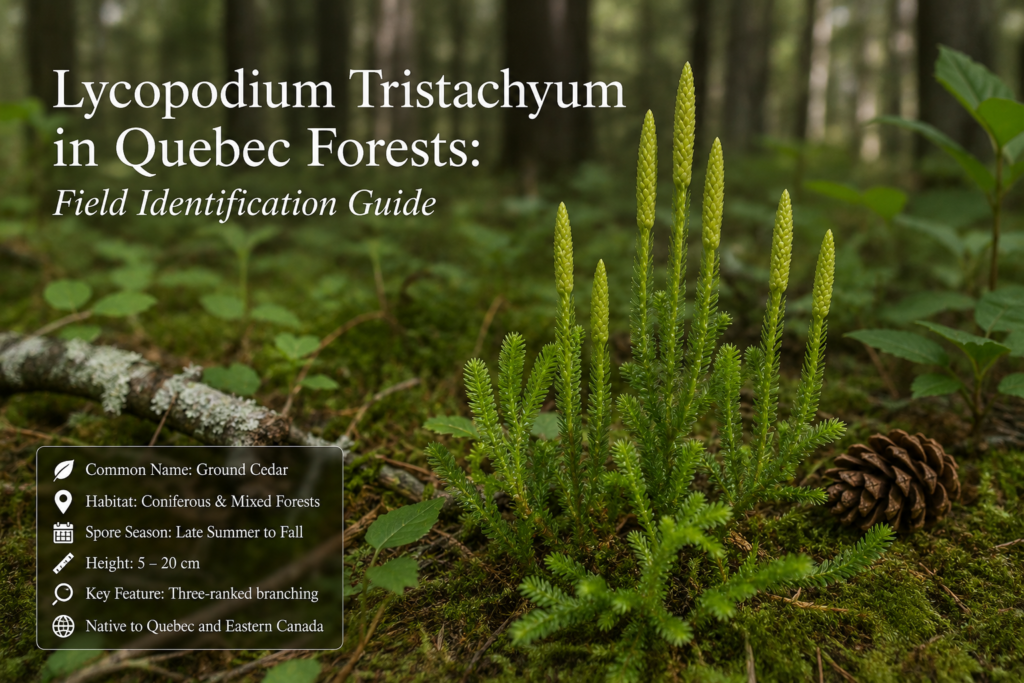
Lycopodium tristachyum is recognized by its trailing stems, upright branching shoots, and narrow spore-bearing structures called strobili. The plant often forms loose mats or spreading patches across the forest floor.
- Scientific name: Lycopodium tristachyum
- Plant group: Clubmoss
- Growth habit: Creeping evergreen groundcover
- Reproduction: Spores produced in terminal strobili
- Habitat: Acidic forest soils, coniferous woods, sandy woodland environments
- Seasonal visibility: Present year-round
The plant’s horizontal stems move along the ground while upright branches rise vertically. The leaves are very small, tightly arranged, and scale-like in appearance. Their texture creates a soft, cedar-like visual effect that explains why some clubmosses are informally called ground cedar.
At the tips of fertile stems, Lycopodium tristachyum develops narrow cone-like structures where spores are produced. These strobili are often arranged in clusters and become more noticeable later in the growing season.
Habitat in Quebec
In Quebec, Lycopodium tristachyum is generally associated with forests that remain relatively stable and lightly disturbed. The species prefers well-drained acidic soils commonly found beneath coniferous canopies or mixed woodland environments.
It may occur near pine, spruce, fir, birch, or hemlock forests where thick organic litter accumulates over time. Sandy soils, moss-covered ground, decomposing needles, and filtered sunlight often create favorable conditions.
Unlike aggressive ground vegetation that spreads rapidly after disturbance, clubmosses typically establish slowly. Areas containing healthy colonies often indicate long-term forest continuity and relatively undisturbed ecological conditions.
The plant is especially sensitive to repeated trampling, soil compaction, and habitat disruption. Because of this, larger patches are usually found away from heavily trafficked recreation zones.
Why Clubmosses Are Ancient Plants
One of the most interesting aspects of Lycopodium tristachyum is its evolutionary history. Clubmoss relatives existed hundreds of millions of years ago during the Carboniferous period when giant lycophyte forests covered large portions of prehistoric Earth.
Those ancient ecosystems contributed significantly to the formation of modern coal deposits. While modern species are small compared to their prehistoric relatives, they still retain primitive reproductive strategies based on spores rather than flowers or seeds.
Observing a clubmoss today offers a rare connection to extremely ancient plant evolution that predates many familiar forest trees and flowering species.
Seasonal Appearance
Lycopodium tristachyum remains green throughout the year, giving it an important ecological role during seasons when deciduous vegetation disappears. In spring and summer, its color contrasts against leaf litter and emerging woodland plants. During autumn, it remains visible beneath falling leaves. In winter, parts of the plant may still appear above shallow snow cover.
Because clubmosses are evergreen, they contribute subtle texture and structure to forest floors during quiet seasons when little other vegetation remains active.
Reproductive Structures and Spores
Unlike flowering plants that rely on seeds, Lycopodium tristachyum reproduces through spores released from specialized structures called strobili. These elongated cones appear at the ends of upright stems and contain spore-producing organs packed closely together.
When mature, spores disperse into the surrounding environment where only a very small percentage successfully develop into new plants. The reproductive cycle of clubmosses is considerably more complex and slower than many common flowering species.
This slow reproductive process is one reason established colonies should not be disturbed or collected from the wild.
Ecological Importance
Although small, clubmosses contribute to forest ecosystem stability in several ways. Their creeping stems help protect surface soils from erosion, while their presence adds diversity to ground vegetation layers.
They also create microhabitats for insects and small invertebrates living within leaf litter and moist organic debris. In mature forests, these low-growing plant communities help maintain humidity and stabilize delicate woodland conditions.
Because clubmosses respond slowly to disturbance, they may also serve as indicators of relatively healthy forest environments.
Common Misidentifications
Lycopodium tristachyum can sometimes be confused with other clubmoss species growing in Quebec forests. Several related species share creeping stems and upright fertile shoots, but differences in branching patterns, leaf arrangement, and strobili structure help distinguish them.
Some species grow more densely while others have flatter branching forms or fewer upright stems. Careful observation of stem shape and reproductive structures improves identification accuracy.
True mosses are also occasionally confused with clubmosses by beginners, but mosses lack vascular tissue and do not produce upright cone-like strobili in the same way.
Responsible Observation and Conservation
Because Lycopodium tristachyum grows slowly and depends on stable habitats, responsible observation is important. Forest floor vegetation can be damaged easily by repeated foot traffic, off-trail shortcuts, and careless photography positioning.
- Stay on established trails whenever possible.
- Avoid stepping directly on clubmoss colonies.
- Do not collect plants from natural habitats.
- Photograph plants without disturbing surrounding soil.
- Respect fragile woodland ecosystems during wet seasons.
Even minor disturbance can break creeping stems or compact the delicate organic layer supporting growth.
Photography Tips for Forest Clubmosses
Photographing Lycopodium tristachyum requires patience because the plant grows close to the ground and often blends into surrounding forest textures. Soft natural light works best, especially during cloudy mornings or shaded afternoon conditions.
Macro photography can reveal fine details in the leaves and strobili, while wider habitat shots help document how the species fits into the surrounding forest environment.
Because these plants often occur in sensitive habitats, photographers should avoid moving leaf litter or flattening nearby vegetation for cleaner compositions.
The Quiet Beauty of Forest Floor Plants
Plants like Lycopodium tristachyum rarely attract the same attention as large flowers or dramatic autumn foliage, yet they contribute significantly to the character of Quebec forests. Their subtle textures, ancient lineage, and evergreen persistence create visual continuity across seasons.
For hikers who slow down and observe carefully, clubmosses reveal a quieter side of forest ecology. They show how much biodiversity exists close to the ground beneath larger trees and shrubs.
These small plants remind observers that natural landscapes are built from countless interconnected organisms, many of which are easy to overlook during faster travel through the woods.
Field Observation Notes
When searching for Lycopodium tristachyum in Quebec, focus on mature forest areas with stable soil and limited disturbance. Scan the forest floor for creeping evergreen mats and upright fertile shoots emerging from acidic organic debris.
Early morning hikes after rainfall can improve visibility because moisture deepens the plant’s green coloration and increases contrast with surrounding leaf litter.
Taking time to observe ground vegetation carefully often reveals additional species nearby, including mosses, lichens, ferns, fungi, and other woodland specialists.
Conclusion
Lycopodium tristachyum is an ancient and remarkable component of Quebec’s woodland ecosystems. Its evergreen creeping stems, spore-bearing structures, and association with mature forest habitats make it an important species for naturalists and plant enthusiasts interested in forest biodiversity.
Although modest in appearance compared to larger flowering plants, this clubmoss represents an extraordinary evolutionary history that reaches back to prehistoric forests long before modern landscapes emerged.
By observing these plants responsibly and protecting the habitats where they grow, visitors can help preserve an often-overlooked part of Quebec’s natural heritage for future generations of hikers, researchers, and nature observers.